
Let’s be brutally honest for a second. We have all experienced that sudden rush of dopamine when we open up our analytics dashboard and see a massive spike in traffic. The green arrow points up. The pageviews are in the thousands. Your latest social media post has hundreds of likes. You lean back in your chair, sip your coffee, and think, “I have finally figured this out.”
But then the end of the month rolls around. You look at your bank account, you look at your actual sales figures, and the numbers tell a completely different story. The traffic is there, but the revenue is completely flat.
Sound familiar? You are not alone.
As a digital strategist who has spent years building websites, optimizing search engines, and untangling complex marketing webs, I see this happen every single day. Business owners are being held hostage by vanity metrics. We have been brainwashed into believing that more eyeballs automatically equal more money. But the harsh truth of the internet in 2026 is that attention is cheap. Trust, however, is incredibly expensive.
If you want to actually grow your business, it is time to stop pushing products at faceless traffic numbers. It is time to start building relationships. Let’s talk about why ignoring vanity metrics to focus on real digital conversations is the ultimate growth hack you have been missing.
The Seductive Trap Of The Dashboard High
Think about vanity metrics like digital cotton candy. They taste great, they give you a quick sugar rush, but they offer absolutely zero nutritional value for your business.
What are vanity metrics? They are the numbers that look impressive on paper but do not correlate to actual business success. I am talking about raw pageviews, social media followers, impressions, and click-through rates on irrelevant blog posts.
Imagine you own a physical retail store. One day, a thousand people walk through your front door. They wander around, look at the ceiling, take a selfie in the mirror, and then walk right back out without buying a single item. Would you call that a successful day of business? Of course not. You would probably call the police.
Yet, when this exact same scenario happens on our websites, we celebrate it. We hire an affordable SEO consultant for startups to bring us more and more traffic without ever asking, “Who are these people, and why are they here?” We obsess over the algorithm instead of obsessing over the human being sitting on the other side of the screen.
The Basic Needs of A Website Before The Conversation Starts
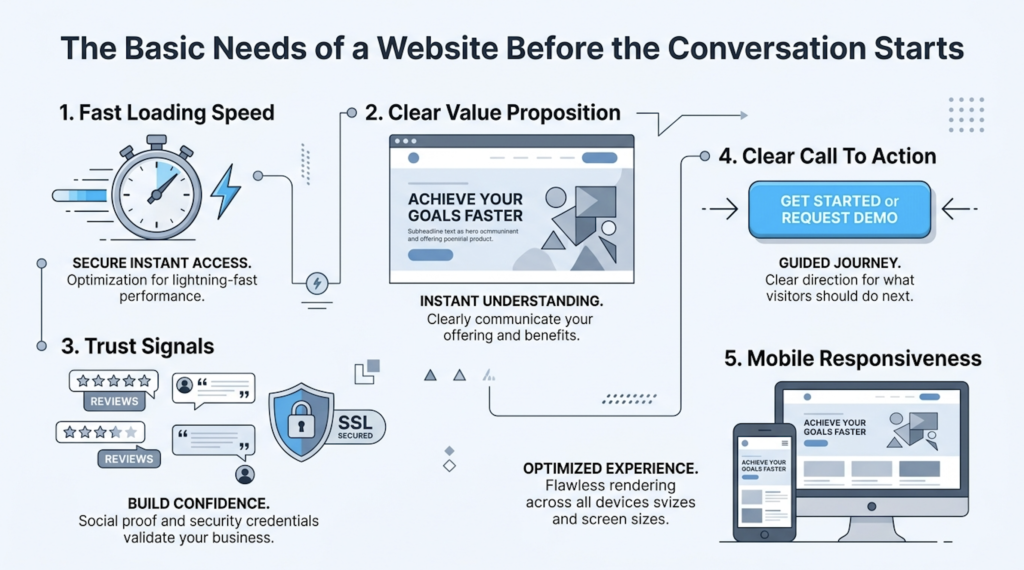
You cannot have a meaningful conversation in a room that is loud, messy, and falling apart. The exact same principle applies to your digital presence. Before you can worry about deep engagement, you must absolutely nail the basic needs of a website.
Your website is your digital living room. If you invite someone over, you want the place to be clean, inviting, and easy to navigate. If a potential client clicks your link and the page takes ten seconds to load, the conversation is over before it even begins. They are gone. This is why a core web vitals optimization service is not just a technical luxury; it is the foundation of digital hospitality.
A website has three fundamental needs to foster a real conversation.
First, it needs speed and security. If your site is broken or throws security warnings, trust is instantly shattered. Second, it needs intuitive navigation. Don’t make your users think. If they have to click four times just to find your contact form, you are actively pushing them away. Third, it needs a crystal-clear value proposition. Within three seconds of landing on your page, a user should know exactly who you are, what problem you solve, and how you can make their life better.
If you are running a generic template that looks like every other business in your industry, you are failing the basic needs test. This is why custom WordPress theme development is so crucial for serious brands. It allows you to design an environment that speaks your unique language. When the basic needs are met, the friction disappears, and the real conversation can finally begin.
From Traffic To Trust The Real Goal Of SEO
I love SEO. I really do. But the SEO industry has a massive ego problem. We love to brag about ranking number one for high-volume keywords, even if those keywords bring in zero dollars.
Let’s say you run a landscaping business in Nashville. An agency promises to get you thousands of hits by writing a viral blog post about “The History of Japanese Gardens.” Great. You get the traffic. But are those people going to hire you to mow their lawn in Tennessee? Absolutely not. You have optimized for traffic, not for intent.
True local SEO services for small business are not about casting the widest net possible. They are about casting the smartest net. I would rather help a client get fifty highly targeted visitors a month who are actively searching for “best retaining wall contractor near me” than five thousand visitors who just want to look at pretty pictures of flowers.
When you focus on intent, you shift from being a billboard to being a consultant. You are answering the specific, painful questions your ideal clients are asking. That is not marketing. That is a conversation.
Related Post: How Email Marketing Automation Develops for Ecommerce Revenue Growth
Designing For Empathy Not Just Clicks
As a designer, I constantly see websites that look like they were built by a robot trying to mimic human emotion. They have massive, aggressive pop-ups that scream “SUBSCRIBE NOW OR LOSE OUT!” They use manipulative countdown timers for sales that never actually end.
This is what happens when you design purely for conversion rate optimization without a drop of empathy. Yes, maybe you trick a few people into giving you their email address. But you have started the relationship on a foundation of annoyance and deceit.
Empathic design is about reading digital body language. If someone is reading an in-depth case study on your site, they are showing high intent. That is the perfect time to offer a soft, relevant call-to-action, like a technical SEO audit checklist they can download.
If they are just browsing your homepage for the first time, back off. Give them space to explore. Stop treating every visitor like a transaction waiting to happen. Treat them like a guest. When you design your Shopify store or WordPress site with empathy, people stay longer, they read deeper, and they eventually buy because they feel understood, not cornered.
Automating The Busywork To Keep The Human Touch
Now, I know what you might be thinking. “Rohan, this all sounds great, but I run a business. I do not have time to sit around having deep, soulful conversations with every single person who visits my website.”
I hear you. And this is where the magic of technology actually shines.
The biggest misconception about automation is that it makes your business feel robotic. When executed poorly, yes, it does. But when executed by a strategist, automation does the exact opposite. It makes you more human.
Think about the repetitive tasks that drain your energy every day. Filtering spam emails, organizing spreadsheets, sending basic onboarding documents, or manually qualifying leads. These tasks steal your most valuable resource: your time.
By implementing tools like n8n automation for marketing agencies or small businesses, you can completely eliminate the busywork. You can build a system that automatically scores a lead based on how they interact with your site, sends them a highly personalized welcoming email, and schedules a call directly to your calendar.
Because the machine is handling the heavy lifting, you now have the time and energy to show up to that sales call fully present. You are not stressed about administrative tasks. You can look the client in the eye, listen to their actual problems, and have a profound, human conversation. Automation should never replace the human touch; it should protect it.

The Metrics That Actually Pay The Bills
If we are throwing vanity metrics in the trash, what should we be looking at instead? How do we measure the quality of a digital conversation?
You need to track engagement metrics and conversion metrics.
Stop looking at “Bounce Rate” and start looking at “Scroll Depth.” Did the user actually read your article, or did they leave after the headline? Stop looking at “Total Sessions” and start looking at “Returning Visitors.” A person who comes back to your site three times is a person who is actively considering working with you. They are listening to what you have to say. Look at “Time on Page.” If you wrote a 2000-word article and the average time on page is twelve seconds, your content is failing to engage.
And most importantly, look at the end result. How many qualified discovery calls did you book this month? What is the lifetime value of the customers coming through your website? When I work as a fractional CMO for small business, I do not let my clients obsess over their Instagram likes. We look at the pipeline. We look at the revenue. We look at the real-world impact of our digital footprint.
Building A Digital Ecosystem Rooted In Relationships
Marketing in 2026 is not about finding one silver bullet. It is about building an ecosystem.
Your SEO strategy brings the right person to the door. Your website design welcomes them in and makes them comfortable. Your content answers their questions and builds authority. And your email marketing continues the conversation long after they have left the site.
Speaking of email, let’s kill the generic newsletter. No one wants a weekly blast of your company updates. If you are using cold email outreach templates B2B, you need to radically change your approach. Stop pitching on the first email. Ask a relevant question. Point out a specific flaw you noticed on their website and offer a free piece of advice on how to fix it.
Be useful. Be helpful. Give away your best advice for free. When you operate from a mindset of abundance rather than scarcity, people naturally gravitate toward you. They stop seeing you as a vendor and start seeing you as a trusted partner.

The Cost Of Continuing To Chase The Algorithm
You have a choice to make. You can keep playing the vanity metric game. You can keep buying fake followers, publishing thin, AI-generated blog posts just to hit a word count, and stressing out every time Google updates its algorithm. You can keep chasing a finish line that constantly moves.
Or, you can step off the treadmill.
You can decide that you are going to build a brand that actually matters. You can choose to optimize your website not just for search engines, but for the living, breathing humans who use it. You can focus on conversion rate optimization for Shopify not by using shady countdown timers, but by writing product descriptions that truly solve the buyer’s pain points.
When you make this shift, marketing stops feeling slimy. It stops feeling like a chore. It becomes an extension of your natural desire to help people. And ironically, when you stop desperately chasing traffic, the high-quality traffic naturally starts to find you. Google’s ultimate goal is to serve the best, most authoritative, most human content to its users. By focusing on real conversations, you are naturally aligning yourself with the future of search.
Final Words
The internet is getting louder by the second. Anyone with a keyboard can generate a thousand pages of content in an hour. The barrier to entry for making noise has dropped to zero. But the barrier to entry for building trust has never been higher.
Your website is not just a digital brochure. It is the frontline of your business. It is your best salesperson, working twenty-four hours a day, seven days a week. But a good salesperson doesn’t just stand on a corner shouting numbers at strangers. A good salesperson listens, relates, and guides.
It is time to look at your analytics dashboard with a heavy dose of skepticism. Ignore the vanity metrics that stroke your ego but starve your bank account. Ensure the basic needs of your website are met so your visitors feel safe and respected. Use automation to buy back your time, and spend that time having real, meaningful digital conversations with the people who need your help the most. Because at the end of the day, algorithms change, trends fade, and platforms die. But human connection? That is the only strategy that never goes out of style.