We are witnessing a profound recalibration of the gig economy. The recent, massive workforce reductions at both Fiverr and Upwork are not just typical corporate cost-cutting measures; they are the warning sirens of a maturing, fundamentally fractured system. As a digital strategist who spends every day helping businesses build real digital ecosystems, I have watched this shift coming from a mile away. The era of transactional, commoditized IT services is dying.
What happens when the giants of the gig economy stumble? And more importantly, if you are a business owner seeking tech talent or a freelancer trying to survive, what exactly happens next? Let’s dive into the harsh realities, the AI revolution, and the future of how work actually gets done.
A Personal Wake-Up Call: My Experience with the Gig Economy
Before we get into the heavy data, I want to share a real scenario that happened to me not too long ago. It perfectly encapsulates why the current freelance marketplace model is breaking down.
In my day-to-day work at Rohan Ahmad, I handle high-level digital strategy, custom Shopify builds, and complex n8n business automation. A few months ago, I was swamped with a massive web migration project and needed some quick, basic data scraping done. It was tedious work, the exact kind of task you would traditionally outsource to a gig platform. So, I posted the job on Upwork.
Within three minutes, I had forty-two proposals. That sounds great, right? Wrong.
Every single proposal was a blatant, AI-generated copy-paste nightmare. They didn’t read my brief. They didn’t understand the nuance of the data I needed. They just used a bot to automatically bid on my keyword. When I finally hired someone who seemed somewhat human, the work they delivered was entirely hallucinated by ChatGPT. I ended up spending more time fixing their mistakes than if I had just written the Python script myself.
This was my wake-up call. The platforms that were built to connect human talent with human needs had become completely overrun by machines talking to machines. As an empathetic architect of digital spaces, I realized that the foundational trust, the very thing that makes business work, had completely evaporated from these marketplaces.
The Harsh Reality Behind the Massive Layoffs at Upwork and Fiverr
If you think my experience was just an isolated incident, let’s look at the cold, hard numbers. The gig economy titans are bleeding, and they are openly admitting it.
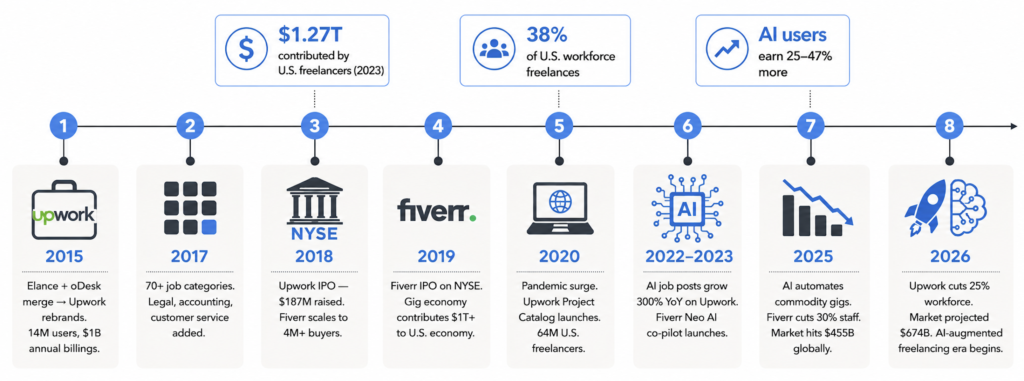
In September 2025, Fiverr sent shockwaves through the industry by slashing roughly 30% of its workforce, about 250 employees. Their CEO declared a radical shift, stating they needed to become an “AI-First” company. They gutted their management layers, desperately trying to return to “startup mode.”
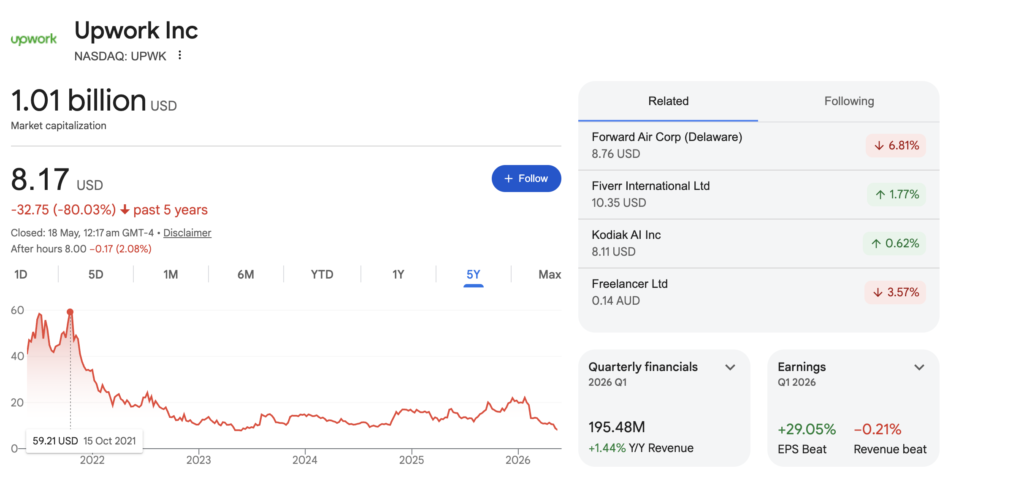
Fast forward to just last week, in May 2026. Upwork dropped a massive bombshell, announcing a 24% reduction in its workforce, cutting approximately one in four employees. Why? Because their growth has slammed into a brick wall. In Q1 of 2026, Upwork posted a microscopic 1.4% revenue growth, sitting at $195.5 million. Their gross services volume was completely flat.
Think about the profound irony here. A platform whose entire multibillion-dollar business model is predicated on helping human beings find work is systematically firing its own human workforce because “the nature of work is evolving.”
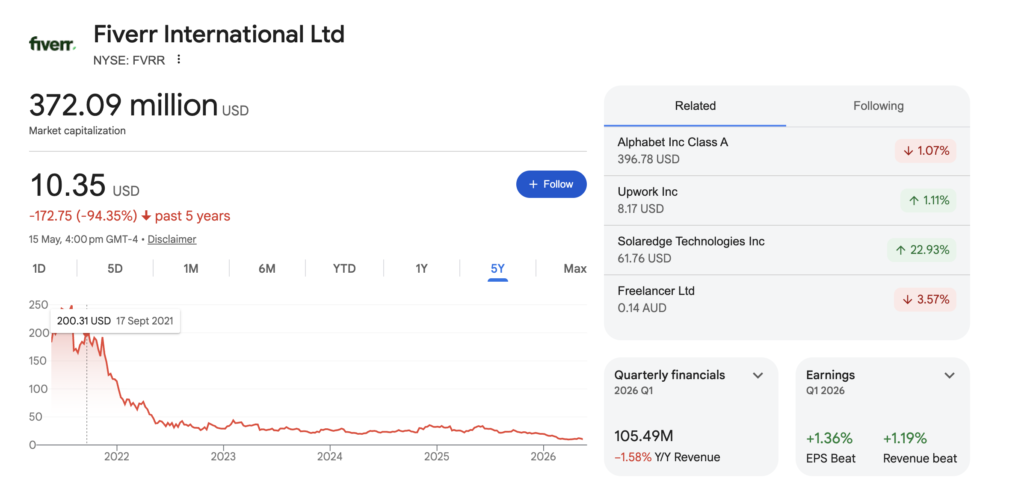
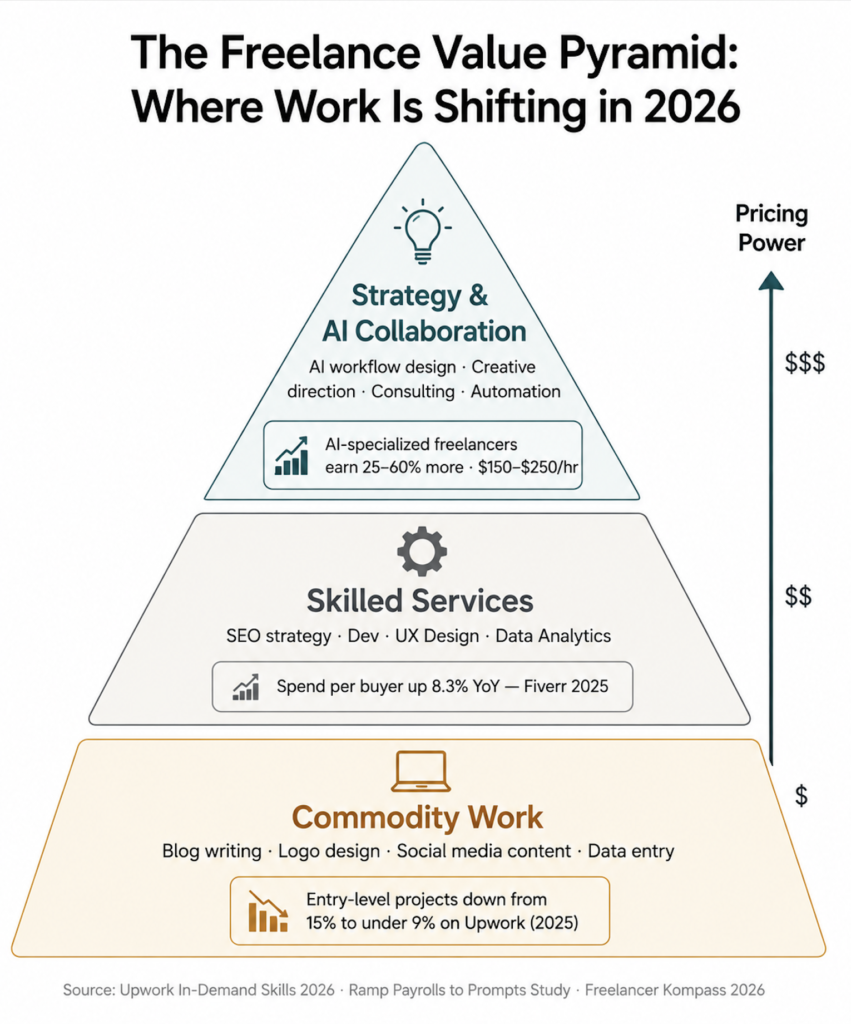
These are not cyclical layoffs. This is structural panic. Both platforms are grappling with declining or stagnant active buyer bases. Investors are skeptical, stock prices have tumbled, and the sheer volume of entry-level freelance work, writing, basic design, entry-level coding, and translation, is evaporating overnight.
Why The Ten Dollar Logo and Cheap Code Are Dead
To understand why IT service provision on these platforms is declining, we have to look at what exactly is being displaced.
For years, Fiverr and Upwork thrived on commoditized labor. If you needed a quick bug fix on a WordPress site, a generic SEO meta-description, or a simple email template, you could find someone to do it for ten bucks. It was a race to the bottom, driven by sheer volume.
But in 2026, artificial intelligence doesn’t just do these tasks faster; it does them better, and it does them for free. Why would a small business owner pay a freelancer on Fiverr to write a basic product description and wait three days for delivery when they can plug their specs into an LLM and get a perfectly optimized paragraph in four seconds?
AI has mercilessly automated routine tasks. This has compressed the demand in commoditized categories to almost zero. The “bottom tier” of the freelance market has been completely wiped out. If your only skill as an IT provider is doing exactly what you are told without adding strategic insight, you have already been replaced.
Oversaturation and the Algorithmic Nightmare
Even for freelancers who possess high-level skills, gig platforms have become hostile environments.
These marketplaces are brutally oversaturated. Because the barrier to entry is zero, millions of people flood the platforms. To manage this chaos, platforms rely on rigid algorithmic biases that heavily favor already-established providers. If you are a brilliant new Shopify developer trying to break into the system in 2026, you are essentially invisible unless you are willing to work for pennies just to accumulate your first few five-star reviews.
Combine this algorithmic suppression with rising platform fees, often taking 20% of a freelancer’s hard-earned money, and the margins for the average IT provider simply disappear. They are doing more work, fighting harder for visibility, paying higher fees, and competing against both global labor markets and sophisticated AI tools. It is a digital sweatshop, and both buyers and sellers are desperate for an exit.
How Client Preferences Are Shifting Away from the Marketplace
Clients are not stupid. They feel the friction. They are exhausted by the lack of quality control.
When a business owner wants to implement a robust email marketing automation strategy, they do not want to hire five different disconnected freelancers to handle the copy, the design, the tech setup, and the analytics. They want continuity. They want a partner who actually understands their business goals.
We are seeing a massive shift in client preferences. Businesses are actively bypassing generic platforms like Upwork and Fiverr. Instead, they are moving toward direct relationships, specialized boutique networks, and internal talent pools. They realize that paying a premium for an expert who can act as a strategic advisor is infinitely more profitable than saving a few dollars on a transactional freelancer who vanishes after the project is done.
Clients are craving outcome certainty. They do not want to buy “hours” of coding; they want to buy a fully functioning, high-converting digital storefront. They want risk mitigation, which a faceless profile on a gig site can never guarantee.
The AI First Pivot Survival Strategy or Desperation
So, how are Fiverr and Upwork responding to this existential threat? They are trying to pivot, desperately attempting to reposition themselves before the ship sinks.
These layoffs represent deliberate “refounding” efforts. Fiverr is leaning heavily into AI integration to automate their own internal operations and enhance their client-freelancer matching systems. Upwork is attempting to position itself as a hybrid human-AI talent platform. The CEO of Upwork famously declared that “two pizza teams are dead,” suggesting that AI allows even smaller, differently resourced teams to make a massive impact.
But is this a winning strategy, or just a survival tactic?
By shifting from volume-driven gig matching to targeting sophisticated, complex work for SMBs, these platforms are essentially trying to become massive, automated digital agencies. They want to orchestrate AI-augmented professional services. However, by embracing AI so aggressively, they are cannibalizing their own user base. The platform that markets itself on the value of human talent is openly touting how technology can reduce human headcount. It is a paradox that leaves many users feeling alienated and betrayed.
The End of Transactional Marketplaces And The Rise Of Orchestration
Despite the gloom and doom surrounding the traditional gig economy, this is far from a terminal decline for IT service provision. What we are actually experiencing is a painful, necessary maturation. The caterpillar is dissolving so the butterfly can emerge.
The winners of the next decade will completely transcend the transactional marketplace model. The future belongs to “intelligent orchestration layers.”
What does that mean? It means the value is no longer in just connecting a buyer to a seller. The value lies in curating premium talent, managing the project, and guaranteeing the outcome. If a client needs a complex headless WordPress architecture built, they don’t want to sift through fifty resumes. They want an orchestration platform that uses AI to thoroughly vet the absolute best engineers, provides a secure environment for the work, and uses AI project management tools to ensure the project stays on track and under budget.
Expect to see massive consolidation and intense specialization. We will see the rise of highly niche platforms, perhaps a network exclusively for vetted n8n automation experts, or a curated hub for high-end Shopify conversion rate optimizers. These hybrid models will allow freelancers to leverage AI to deliver massive scale, while still commanding premium rates for their strategy, oversight, and unique human creativity.
Upskilling In the Age of AI What Freelancers Must Do Now
If you are an IT service provider, a developer, an SEO specialist, or a digital marketer, the writing is on the wall. You can no longer sell your hands; you have to sell your brain.
The imperative right now is rapid upskilling. You must embrace AI not as a competitor, but as a hyper-intelligent collaborator. If you write code, you need to be using AI copilots to speed up your boilerplate generation so you can focus on complex system architecture. If you run Google Ads, you need to let AI handle the bid adjustments while you focus on the deep psychological triggers of the ad copy and the overarching customer journey.
You must transition from a “doer” to a “reviewer” and a “strategist.” The clients of 2026 will happily pay for your taste, your judgment, your empathy, and your ability to look at a holistic business problem and engineer a solution. They will not pay you to do data entry.
Furthermore, you have to master direct client acquisition. If you are relying on Upwork algorithms to feed your family, you are playing Russian roulette with your career. You need to build your own brand, create your own lead generation funnels, and own your audience.
How To Build a Resilient IT Business Outside the Gig Platforms
This brings me to the core philosophy I practice and preach. How do you survive and thrive when the big platforms are crumbling? You build your own digital living room.
You must focus on the basic needs of a website, your own website. Is it fast? Is it secure? Does it clearly articulate your unique value proposition? If you are an IT provider and your own digital storefront looks like a messy template from 2018, no high-paying client is going to take you seriously.
You need to implement your own SEO and Answer Engine Optimization (AEO) strategies. When a local business searches for “how to integrate Klaviyo with Shopify to reduce abandoned carts,” you want them to find an incredibly detailed, empathetic, human-written article on your website, not a generic Fiverr profile.
Stop obsessing over vanity metrics and start focusing on real digital conversations. Give away your best knowledge for free. Show your face on camera. Explain your process. Share the times you failed and what you learned from it. This vulnerability and transparency create a human moat that no artificial intelligence can ever cross.
When you build a resilient, relationship-centric model, you stop competing on price. You are no longer just another developer bidding $15 an hour against a thousand other people. You become a trusted advisor. Enterprises and SMBs alike are desperate for flexible, high-impact talent without the legacy overhead of full-time employees. They have the budget; they just need to know they can trust you.
The Policy and Equity Challenge
We cannot ignore the human cost of this transition. As platforms pivot and AI automates the lower tiers of work, millions of people who relied on these digital micro-tasks are being displaced.
Policymakers, educational institutions, and even the platforms themselves have a moral obligation to address this equity gap. We need robust support systems, aggressive retraining programs, and new frameworks for worker protection in a hybrid AI economy. We cannot simply leave an entire generation of digital workers behind while we celebrate unprecedented corporate efficiency. Fostering innovation must go hand-in-hand with supporting human transitions.
Final Words
The decline of traditional IT service provision on platforms like Upwork and Fiverr is not the end of freelance work; it is the end of the digital sweatshop. The fantasy that you could build a sustainable, high-growth business purely by connecting cheap hours to basic tasks has officially shattered under the weight of artificial intelligence and shifting market demands.
But out of this disruption comes the greatest opportunity for digital professionals in a generation. The freelance economy is evolving toward immense efficiency and extraordinary value. The providers who will define the next decade are the empathetic architects, the ones who use AI to eliminate the busywork so they can focus entirely on human ingenuity, deep strategic thinking, and genuine relationship building. The gig platforms of the future will not merely connect a buyer to a seller; they will enable human talent at an unprecedented scale. If you are ready to stop acting like a machine and start acting like a trusted partner, the market has never been more ready for you. Build your own ecosystem, master the new tools, and step out of the marketplace shadows. The world doesn’t need more cheap labor; it needs your unique, irreplaceable perspective.